
The cannabis industry has evolved from a fragmented, state-driven market into a rapidly expanding global sector shaped by legalization, scientific research, and shifting consumer attitudes. Once considered a niche category, cannabis is now integrated into pharmaceuticals, wellness products, food and beverages, and even cosmetics.
Understanding cannabis industry statistics is essential for grasping how quickly the market is scaling and where it is headed next. The data shows strong growth across global markets, increasing adoption in the United States, expanding legalization frameworks, and rising consumer usage across different age groups and demographics. At the same time, the industry is facing regulatory, pricing, and public health challenges that continue to shape its trajectory.
This article compiles the most important verified cannabis industry statistics from industry research and public health studies to provide a clear, data-driven overview of the cannabis landscape.
Cannabis Industry at a Glance
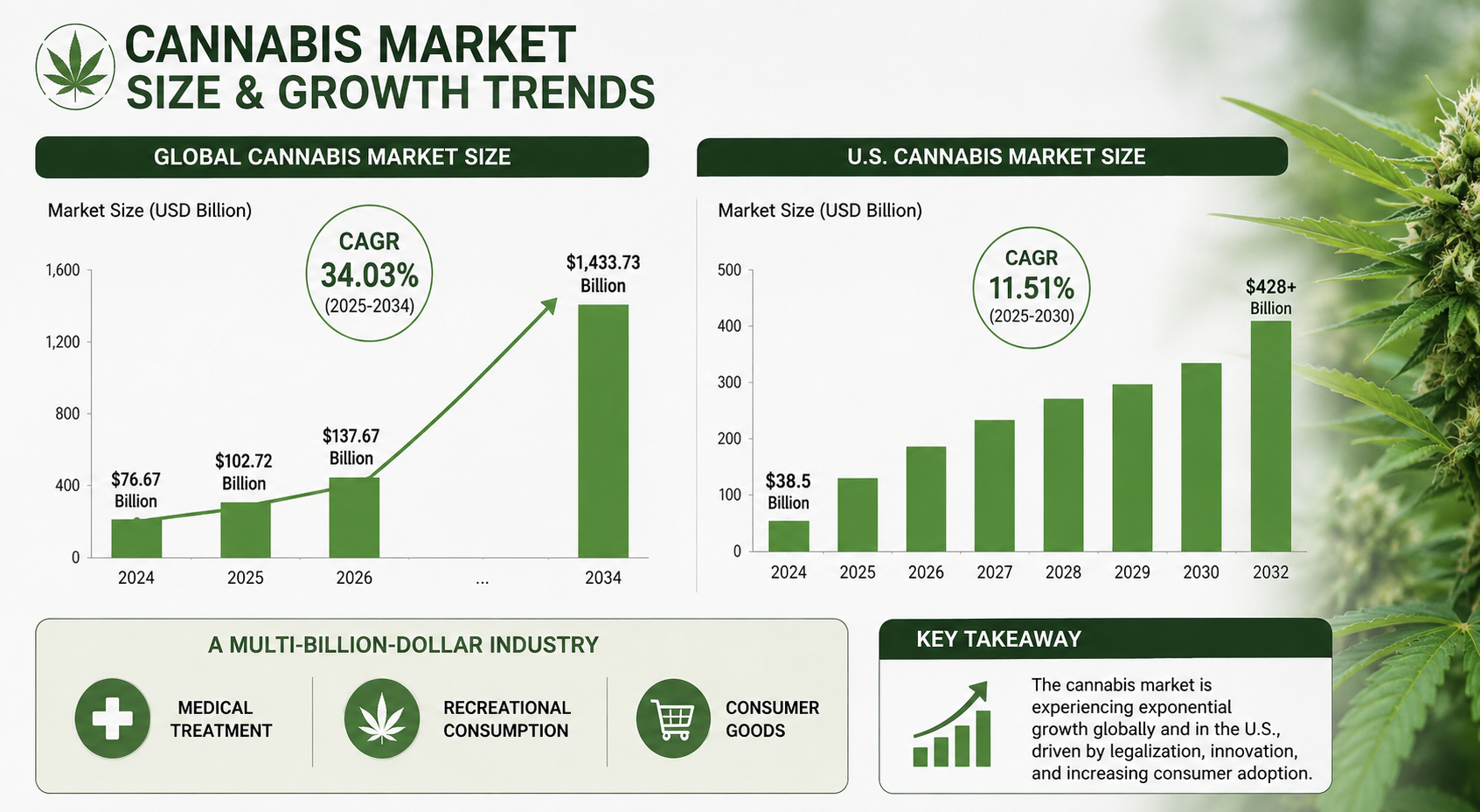
The cannabis industry has reached a significant scale globally and continues to accelerate. In 2025, the global cannabis market was valued at USD 102.72 billion, and it is projected to grow to USD 137.67 billion in 2026, with long-term forecasts reaching USD 1,433.73 billion by 2034, reflecting a CAGR of 34.03%.
In the United States, the market is also expanding rapidly. Estimates place the U.S. cannabis market at USD 38.5 billion in 2024, with expectations of steady growth through 2030 at a CAGR of 11.51%. Broader projections suggest the U.S. market could reach over USD 428 billion by 2032, driven by legalization, product innovation, and increasing consumer adoption.
Cannabis is no longer a marginal industry. It is now a multi-billion-dollar sector embedded across multiple verticals including medical treatment, recreational consumption, and consumer goods.
Market Size and Growth Trends
One of the most defining cannabis industry statistics is the speed of market expansion. North America continues to dominate globally, accounting for approximately 83.82% of the global cannabis market share in 2025. This dominance is largely driven by widespread legalization across U.S. states and Canada's early regulatory adoption.
The growth of the industry is closely tied to regulatory expansion. In the United States, recreational cannabis is legal in 24 states, while medical cannabis is legal in 42 states. These legal frameworks have enabled consistent market expansion and investment inflows.
Revenue projections highlight the long-term trajectory of the industry. The global cannabis sector is expected to continue compounding rapidly over the next decade, while the U.S. market alone is projected to surpass hundreds of billions in value as legalization becomes more widespread and consumer adoption increases.
Cannabis Consumer Statistics and Usage Patterns
Cannabis consumption is now deeply embedded in mainstream behavior. According to national survey data, approximately 47% of Americans have tried cannabis at least once, while around 15% identify as current users. In addition, more than 22% of individuals aged 12 and older reported cannabis use in the past year, representing over 64 million people.
Usage patterns show increasing normalization. A growing share of consumers use cannabis regularly, with 42% of users classified as daily or near-daily consumers. This shift indicates that cannabis is no longer only occasional-use but has become part of routine consumption habits for many users.
Demographics also reveal important trends. More than one in three women over 21 in the United States consume cannabis, and women now represent a growing share of the consumer base. At the same time, older adults are increasingly participating in the market, with usage among those aged 65 and older rising significantly in recent years.
Consumers primarily use cannabis for relaxation and wellness-related reasons. The most common motivations include stress relief, anxiety reduction, pain management, and sleep support.
Product and Market Segmentation Statistics
Cannabis consumption is no longer limited to traditional flower products. While flower remains the dominant category, accounting for a significant share of industry revenue, the market has diversified significantly.
Flowers and pre-rolls continue to show steady growth, while edibles, vapes, concentrates, and beverages are gaining traction. As the cannabis industry continues shifting toward more processed and standardized product formats such as oils, edibles, and pre-rolls, producers are increasingly investing in automation to improve consistency, efficiency, and scalability in production lines, including the adoption of automated pre-roll machines for high-volume manufacturing of pre-rolled products.
Online sales also play a growing role, with approximately 25% of cannabis sales now occurring digitally, including delivery and pickup services. Consumer preferences vary by generation and lifestyle. Younger consumers, particularly Gen Z and Millennials, are more likely to prefer vape products, while older consumers tend to spend more per purchase and favor traditional retail interactions.
Product innovation is also shaping growth. The industry is seeing rapid expansion in CBD-based products, THC-infused beverages, and functional wellness products, reflecting a shift toward more diversified consumption methods beyond smoking.
Legalization and Economic Impact
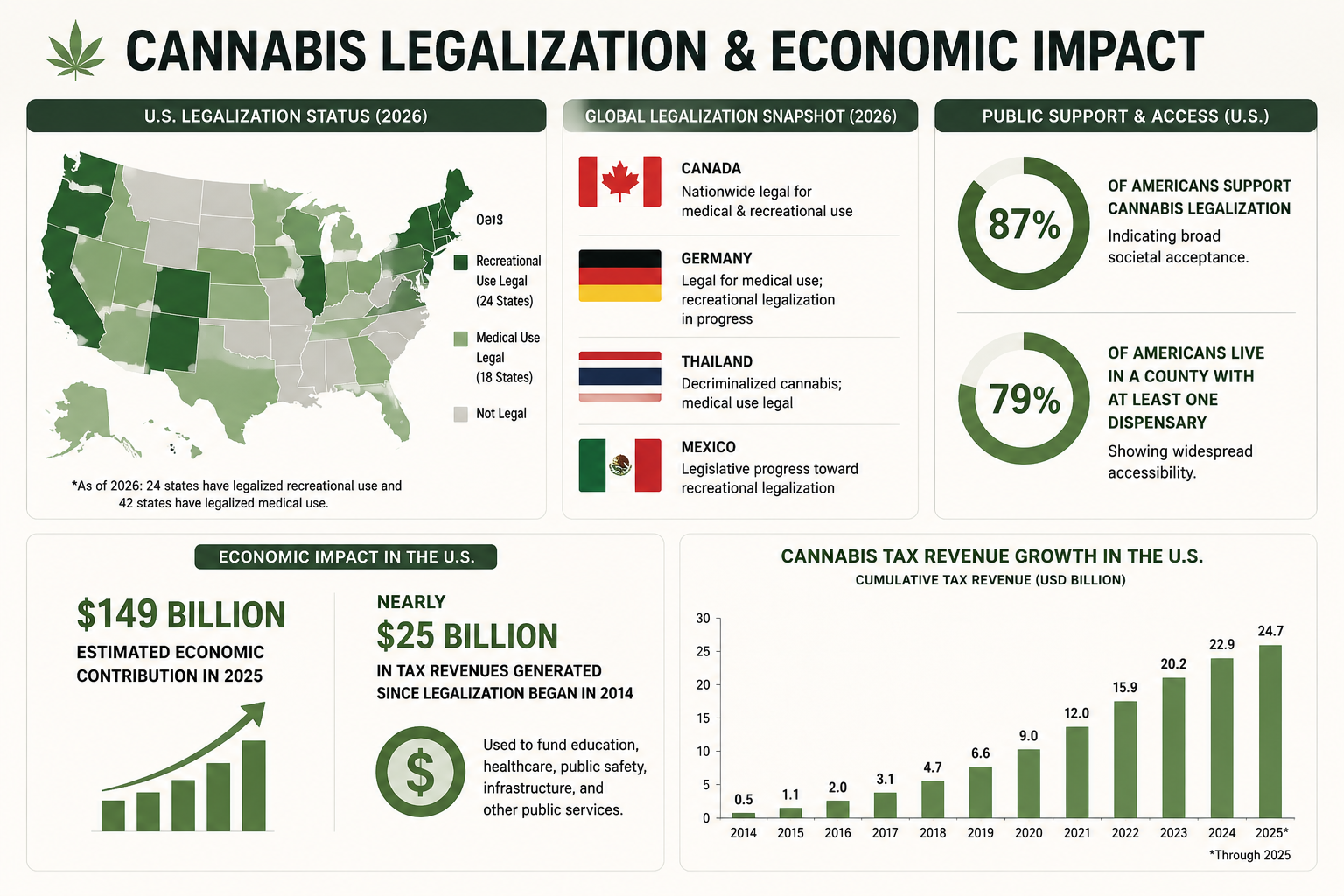
Legalization remains one of the most important drivers of cannabis industry growth. As of 2026, cannabis is legal for recreational use in 24 U.S. states, and for medical use in 42 states. Globally, countries such as Canada, Germany, Thailand, and Mexico are advancing regulatory frameworks that support both medical and recreational use.
Public support is also strong. Approximately 87% of Americans support cannabis legalization, indicating broad societal acceptance. Additionally, 79% of Americans live in a county with at least one dispensary, showing how accessible the industry has become.
The economic impact is substantial. Cannabis contributed approximately USD 149 billion to the U.S. economy in 2025, while tax revenues from legal cannabis have reached nearly USD 25 billion since legalization began in 2014. In some states, cannabis taxation has become a major revenue source supporting education, healthcare, and public services.
Employment and Industry Development
The cannabis sector is also a significant employer. The industry supports approximately 425,002 full-time equivalent jobs in the United States, although recent data shows slight fluctuations due to pricing pressure and regulatory costs.
Despite short-term adjustments, long-term employment projections remain strong, with expectations of continued job growth as legalization expands into new states and international markets.
Investment activity remains active, with companies expanding through mergers, acquisitions, and product diversification. However, the industry is also experiencing challenges such as price compression, regulatory burdens, and shifting consumer spending patterns.
Public Health and Medical Cannabis Statistics
Cannabis use is increasingly tied to medical and therapeutic applications. Studies show that a large share of consumers use cannabis for relaxation, pain relief, anxiety management, and sleep improvement. Additionally, cannabis-derived medications such as Epidiolex, Marinol, Cesamet, and Syndros are approved for specific medical conditions.
However, public health research also highlights risks. Frequent cannabis use has been linked to cannabis use disorder (CUD), which affects millions of users. Long-term and high-frequency consumption is associated with cognitive, psychological, and physical health impacts, particularly when use begins at a young age.
At the same time, medical cannabis continues to be explored for conditions such as chronic pain, epilepsy, PTSD, and chemotherapy-related symptoms, making it a dual-impact industry with both therapeutic potential and health concerns.
Conclusion
Cannabis industry statistics reveal a market undergoing rapid transformation. With global valuations surpassing $100 billion and long-term projections reaching over a trillion dollars, cannabis is becoming one of the fastest-growing industries worldwide.
At the same time, legalization is expanding, consumer adoption is increasing, and product innovation is reshaping how cannabis is used. The United States remains the central driver of this growth, both in terms of market size and regulatory development.
However, the industry is not without challenges. Pricing pressure, regulatory complexity, and public health concerns continue to influence how the market evolves. Despite these challenges, the data clearly shows a consistent trend: cannabis is shifting from an emerging industry into a mainstream global sector.